
Photo credit: Leon Harris
As we’ve entered the second eclipse season of the year, I thought it would be a good time to reflect on the benefits a little stress can have in our lives. And you might react to that statement with something like… “A little? A little? This isn’t a little! We’re swimming in stress every day right now!”, which is true. But people have seen even more stressful times than these (think World War I and II, the Civil War, the Korean War, the Great Depression, you name it) when survival was a daily, if not moment by moment question. So, with that perspective in mind and with the very real and valid stressors that we face today, the question I ask myself is, how can we survive, and perhaps thrive with a moderate level of stress in our lives? And as with all things human, I look to the plants for answers.
Plants have been adapting to stress for over 600 million years, longer than humans have been in existence, so they can teach us a thing or two. When plants first moved from water on to land, roughly 470 to 500 million years ago, they faced severe new stressors like intense UV radiation, extreme temperature shifts, and drought. These new stressors forced them to adapt. Algae and other early plant life developed genetic networks to manage basic cellular stress. When plants moved to land, they evolved advanced defenses against drying out, bright sunlight, and gravity. In more recent times, studies by the National Institute of Health and Pennsylvania State University, have discovered that plants develop a set of dimmers or switches in their DNA that turn on or off under stress and control which proteins are made. The proteins that are made affect how the plant responds to stress.
Take the cactus for example. The cactus has evolved over time to be able to survive and thrive in extreme drought conditions by storing water in thick parts and opening small breathing holes at night to stop water loss.
Some trees like the Eucalyptus tree have learned to develop deep roots to tap hidden water in order to survive.
If there’s say too much salt in the environment (imagine near the ocean), plants like the Salt Bush store extra salt in old leaves that fall off the plant so the rest of it stays safe.
What if it’s freezing cold outside? Well, the Pine tree has adapted to create natural chemicals like sugar and oils that act like antifreeze inside its cells in order to stay warm.
Similarly, humans have learned to adapt to stress through hormesis—a process where mild, manageable stress triggers cellular survival and repair pathways rather than damage. In other words, what doesn’t kill your cells makes them stronger.
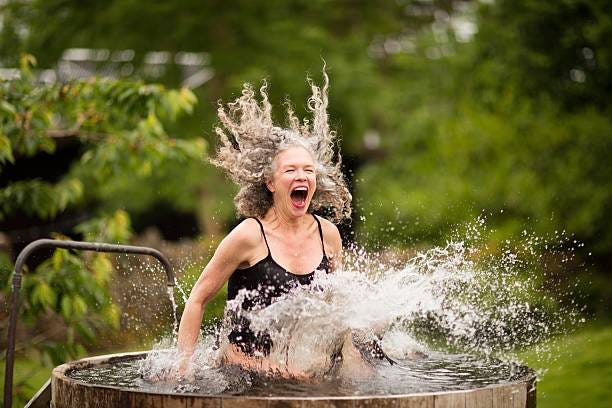
The core idea is that small doses of stress trigger self-healing. Large doses of stress cause actual damage. Just like lifting weights creates tiny muscle tears that heal back stronger, a little bit of cellular stress forces your body to clean and repair itself. Think of it as a low-level alarm that shocks your body’s internal maintenance crew into action, making your system more resilient before a real emergency happens. In fact, this is the whole concept behind vaccines. They give your cells a tiny, harmless dose of hardship which teaches them how to fight off much bigger threats later. Similarly, fasting (mindful meal skipping) activates cellular cleanup. Or look at the latest trend of cold plunges (which humans seem to instinctively recognize the benefits of). Studies by Stanford University indicate that repeated short dips into freezing water boosts brain and body resiliency by activating protective genetic pathways and training the brain to react less intensely to future stressors.
And to give everyone even a little more hope, we humans have this thing called free will and conscious awareness, which means that we have the ability to choose how we adapt (to some degree) or at least to choose where we puts our concerted efforts in learning how we might better be able to adapt.
With that in mind, I’m going to jump in some freezing cold water!
True! Plants are so good at adapting to stress that we don’t actually know what they are capable of looking like in the wild. In letting my yard go feral this year I’ve noticed that some plants get so much taller when they don’t have to fear a lawn mower. They’ll actually grow low to the ground in yards but can grow so much taller if they ‘know’ they can. So wild! Also, interestingly, cold plunges aren’t as good for women as they are for men. Or so I’ve read. Especially as we age. But, to each his own and as my hot flashes ramp up a cold plunge sounds delightful. :)